
- Home
- Suppliers
- Products
-
- Services
- Applications / references
- About us
- Contact
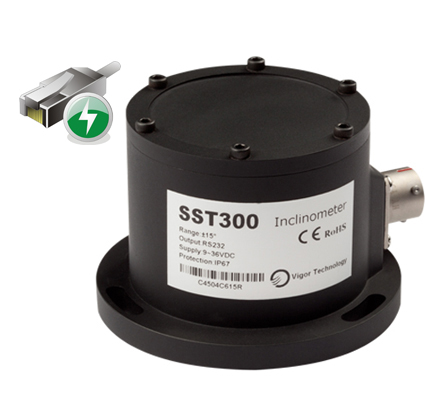
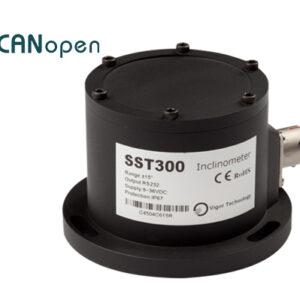
Ethernet inclination is a multi-functional tilt device developed by Vigor. It integrates a TCP/IP protocol stack, allowing users to apply network functions to their field conditions easily without deep knowledge of networking or TCP/IP protocols.
The device includes a 10/100M self-adaptive Ethernet interface and supports serial baud rates up to 230.4 kbps. It provides modes including TCP Server, TCP Client, UDP, and Real COM driver.
With option SST003-05-14, multiple Ethernet inclinometers can easily form a local network; option SST003-05-15 can extend the local network to a WAN for remote data query and measurement function settings.

TCP Server: waits for TCP Client connections; once connected, bidirectional data transmission is available.
TCP Client: actively connects to a destination TCP server and retries per settings until connected; once connected, bidirectional data transmission is available.
Real COM: operates as TCP Server; a background service on the host establishes a connection and creates a virtual serial port for seamless PC–device serial communication over Ethernet.
UDP: connectionless transmission with lower overhead and higher real-time rate than TCP; for high reliability, add an upper-layer protocol. In UDP mode, devices are peer-to-peer (no server/client).
Works with an Ethernet PBX to build multi-node networks. A remote host can query each inclinometer via a router connected to Wi-Fi/ZigBee/Ethernet/GPRS or other networks (3G, GPRS).
PoE (802.3af): power interface PSE/PD over cable; Alternative A (1,2,3,6 signal pairs) and Alternative B (4,5,7,8 spare pairs).


Example: dual-axis inclinometer, range ±30°, room temperature accuracy ±0.02°, −20~60 ℃ drift accuracy ±0.02°, Ethernet output, 25 m cable with plug, vibration suppression function — model:
SST302-30-G9-F5-00-C12-D3 (25m).
Options (see Table 4): PC application software — SST003-04-09; Magnetic base — SST003-01-01; 8-port industrial Ethernet switch — SST003-05-14.
| Item | Order Code | Accessories Name | Function |
|---|---|---|---|
| Functional model (built-in) | F1 | GPS module |
Positioning accuracy 2.5 m CEP; 2.0 m @ SBAS Local g automatic revision; time pulse 30 ns RMS; 4 Hz raw data Speed accuracy 0.1 m/s; GPS L1 C/A; higher-accuracy GPS available |
| F4 | Gyro module |
±100/250/400°/s X/Y/Z dynamic angular rate; in-run bias ±0.02°/s; non-linearity 0.1%FS; 50 Hz BW; noise density 0.02°/s/√Hz; higher-accuracy option available |
|
| F5 | Vibration module |
3-axis detection ≤5 kHz; ranges 0g~±1g/±5g/±10g/±20g (adjustable); 20.48 kSPS real-time sampling; programmable filter (11 points); 512-point real-valued FFT on X/Y/Z; stores 14 FFT records; 6 alarm bands |
|
| Temperature drift | D1 | Temperature drift | Compensation 0~60 ℃; accuracy ±0.01° @ ≤±30° |
| D2 | Temperature drift | Compensation 0~60 ℃; accuracy ±0.01° @ >±30° | |
| D3 | Temperature drift | Compensation −20~60 ℃; accuracy ±0.02° @ ≤±30° | |
| D4 | Temperature drift | Compensation −20~60 ℃; accuracy ±0.02° @ >±30° | |
| D5 | Temperature drift | Compensation −30~60 ℃; accuracy ±0.03° @ ≤±30° | |
| D6 | Temperature drift | Compensation −30~60 ℃; accuracy ±0.03° @ >±30° | |
| D7 | Temperature drift | Compensation −40~65 ℃; accuracy ±0.05° @ ≤±30° | |
| D8 | Temperature drift | Compensation −40~65 ℃; accuracy ±0.05° @ >±30° | |
| D9 | Temperature drift | Compensation −40~85 ℃; accuracy ±0.05° @ ≤±30° | |
| D10 | Temperature drift | Compensation −40~85 ℃; accuracy ±0.05° @ >±30° |
| Item | P/N | Option Name | Function |
|---|---|---|---|
| Installation tools | SST003-01-01 | Magnetic base | 50 kg suction, permanent magnet, stainless steel |
| SST003-01-04 | Adjustable base with micrometer screw | Three-point adjustment, 0.001 mm resolution, stainless steel | |
| Software | SST003-04-09 | PC application software | Setting / Command / Tool functions; Windows XP / Windows 7 |
| Network access facility | SST003-05-14 | 8-port industrial Ethernet switch | Industrial ring <5 ms failover; VLAN (IEEE 802.1q); RSTP/STP; IEEE 802.1x authentication |
| SST003-05-15 | LAN/WAN converter | 10/100 Mbps; 100 m; 1500 V isolation; full/half-duplex; VLAN long packets; MAC filter | |
| Power | SST003-09-02 | Portable battery packs | 24 VDC output, 24 hours continuous, IP65, rechargeable |
| Test report | SST003-11-01 | Cross-axis error | Banking tilt accuracy report, average 11 points (full range) |
| SST003-11-03 | Allowed installation misalignment | Axis migration report for vertical & horizontal axes (3 angles) | |
| SST003-11-04 | Response time & hysteresis | Time response curve/data and hysteresis characteristics |
Copyright 2026 © All rights Reserved. Hemsida Webbdesign Interwebsite Webbyrå